
✕
Share Your Feedback
We’d love to hear from you
Thank you! Your submission has been received!
Oops! Something went wrong while submitting the form.


Teen mental health counseling has helped thousands of families recognize that what looked like "just a bad mood" was something far more serious. When your child stops sleeping, withdraws from friends, loses interest in school, or seems exhausted no matter how much they rest, it can feel alarming and confusing. Stress and burnout in teenagers are real, rising, and treatable with the right support.
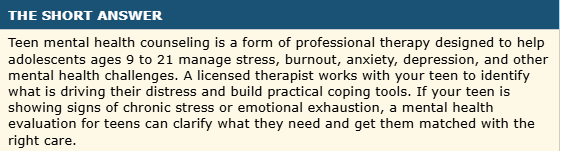
Most teenagers feel stressed. Exams, social pressure, family tension, and the transition into adulthood all generate real anxiety. But burnout is not the same as stress. Stress is a temporary pressure that eases when the situation changes. Burnout is a state of chronic emotional, physical, and mental exhaustion that does not go away with rest.
In teens, burnout often builds slowly. A student who was once driven and engaged starts skipping activities they used to love. A social teenager becomes increasingly withdrawn. A child who managed their emotions reasonably well now erupts over minor things or goes numb entirely.
The challenge for parents is that teenagers rarely have the words to say "I am burned out." Instead, they show you through behavior changes, physical complaints, and emotional withdrawal.

Recognizing the signs early matters. The earlier a teen receives adolescent mental health counseling, the faster they can recover and build the skills to manage future stress.
Watch for these warning signs:
Any one of these signs could have a simple explanation. But when several appear together, or when a single sign persists for two weeks or more, it is time to consider a mental health evaluation for teens.

If you suspect your teen is struggling, the first formal step is usually a mental health evaluation for teens. This is a structured assessment conducted by a licensed mental health professional. It is not a test your teen can pass or fail. It is a conversation and a process designed to understand them more fully.
A typical evaluation includes:
The evaluation helps identify whether your teen is experiencing anxiety, depression, burnout, ADHD, trauma responses, or another condition. It also clarifies what kind of support is most appropriate, whether that is weekly teen mental health counseling, more intensive outpatient care, psychiatric evaluation, or a combination.

At Mount Behavioral Health, our evaluations are conducted by licensed clinicians trained to work with children and teenagers ages 9 to 21. We see many families who come in unsure whether their teen "qualifies" for help. The answer is almost always yes. If something feels wrong, we want to hear from you.
Not all adolescent mental health counseling looks the same. The right approach depends on your teen's specific needs, age, and comfort level.
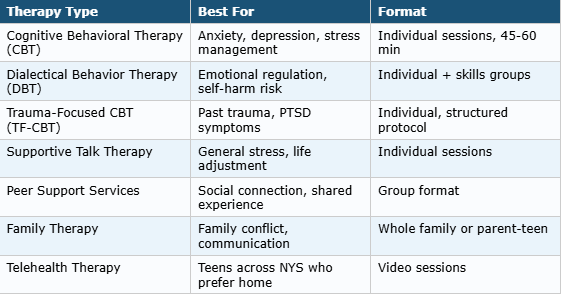
Mount Behavioral Health offers telehealth therapy as a primary format, which means your teen can attend sessions from home across New York State. This removes the barrier of transportation and the stigma some teens feel about walking into a clinic.
When a teenager is burned out, getting them out of the house for an appointment can feel impossible. Telehealth therapy solves this. Your teen can connect with a licensed therapist from the privacy of their bedroom, which many teens actually prefer.
Research supports this approach. Telehealth therapy is as effective as in-person care for anxiety and depression, which are two of the most common conditions underlying teen burnout. It also tends to improve attendance rates, since removing logistical barriers reduces cancellations.
For families using Medicaid or other insurance, telehealth sessions are typically covered at the same rate as in-person visits. This makes ongoing teen mental health counseling far more accessible for families across New York City.
Source: https://www.nimh.nih.gov/health/topics/child-and-adolescent-mental-health
Many parents know their teenager needs support, but are unsure how to bring it up without triggering resistance. Here are approaches that work:
Lead with observation, not diagnosis. Instead of "I think you have anxiety," try "I've noticed you seem really tired lately, and I want to make sure you're okay."
Ask questions, not just for answers. "Is there anything that's been feeling heavy lately?" opens a door that "What's wrong with you?" slams shut.
Normalize the idea of therapy. "A lot of teens talk to someone when things get stressful. It's like having someone who's only there to listen to you." Frame it as a strength, not a problem.

Give them some control. Ask if they want to be involved in choosing a therapist, or whether they prefer in-person or video sessions. Autonomy matters to teenagers.
Be patient with resistance. Some teens will push back initially. Keep the door open and be consistent. Many teens come around once they understand therapy is private and no one is there to judge them.
One of the biggest worries for families is cost. The good news is that mental health therapy is covered under most major insurance plans, and under New York State law, insurance companies must cover mental health services at the same level as physical health services.
Mount Behavioral Health accepts most major insurance plans, including Medicaid. This matters enormously for the families we serve, many of whom are on tighter budgets and may have assumed private adolescent mental health counseling was out of reach.
Here is what to ask when verifying your coverage:
If you are unsure, our staff can help you verify your benefits before your teen's first appointment. Call us at (718) 400-0545.
At what age can a teen start mental health counseling?
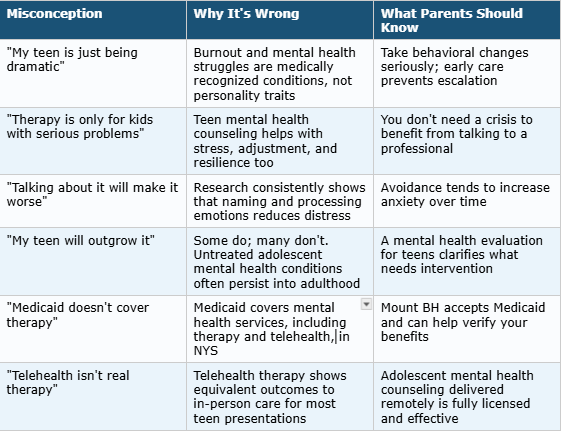
Mount Behavioral Health works with children and teenagers ages 9 to 21. The right time to start is when you or your teen notices persistent signs of distress, not after things have reached a crisis point. Many families come to us earlier than they think they "should" and are glad they did. There is no minimum level of struggle required to benefit from teen mental health counseling.
How long does adolescent mental health counseling take?
It depends on your teen's needs. Some teens make meaningful progress in 8 to 12 sessions. Others benefit from longer-term support, particularly if they are working through trauma or complex anxiety. After an initial evaluation, your teen's therapist will outline a general treatment timeline and adjust based on progress.
What happens during a mental health evaluation for teens?
An evaluation typically includes a structured clinical interview with your teen, a separate conversation with you as the parent, and standardized questionnaires. It is designed to understand your teen's history, current challenges, strengths, and goals. The process is collaborative and private. Most evaluations are completed in one to two sessions.
Can my teen's therapy be kept confidential?
Yes. Therapists maintain confidentiality with their teenage clients as a general rule, which encourages teens to speak openly. There are limits to confidentiality. Specifically, if a therapist believes your teen is at risk of harm to themselves or others, they are required to notify you. Outside of those situations, what your teen shares in sessions is protected.
Does telehealth therapy work for teens?
Research supports telehealth as equally effective as in-person care for most adolescent mental health presentations, including anxiety, depression, and stress. Many teens prefer video sessions because they can participate from the privacy of their own room, which often reduces the emotional barrier to opening up. Mount BH offers telehealth teen mental health counseling across all of New York State.
What if my teen refuses to go to therapy?
This is common and does not mean your teen will never accept support. In the meantime, you can speak with a therapist yourself for guidance on how to support your teen at home. Many teens come around when given some control over the process, such as choosing their therapist or format. Consistent, calm encouragement over time makes a real difference.
Does Mount Behavioral Health accept Medicaid?
Yes. Mount Behavioral Health accepts most major insurance plans, including Medicaid. We serve many families for whom cost is a real concern, and we are committed to making adolescent mental health counseling accessible. Call us at (718) 400-0545 to verify your specific coverage before your first appointment.
- Mental Health Therapy in Brooklyn
- Teen Telehealth Therapy in Manhattan
- Adolescent Mental Health Services in Queens
- Child Telehealth Therapy in the Bronx
- Mount Behavioral Health Homepage
Get Support for Your Teen in NYC
Mount Behavioral Health offers licensed telehealth therapy for children and teens ages 9 to 21 across NYC. We accept most major insurance plans, including Medicaid. Sessions are available in English and Spanish.
Call (718) 400-0545 or schedule online at mountbh.org.


