
✕
Share Your Feedback
We’d love to hear from you
Thank you! Your submission has been received!
Oops! Something went wrong while submitting the form.
Your eight-year-old won't walk past the neighbor's dog on your Brooklyn block. Your teen has started skipping school trips because the subway feels impossible. When a fear starts shaping your family's routine, it is natural to wonder whether it is a phase or something more. The good news is that phobia treatment for children is one of the most effective areas of child mental health care. With the right support, most kids learn to face the thing they fear, often in a matter of weeks. This guide explains how to spot a phobia, what treatment actually looks like, and how NYC families can get help.
Fear is a normal part of growing up. It keeps kids cautious around real dangers, and most childhood fears fade on their own as children gain experience and confidence.
A fear may have crossed into a phobia when:
Physical symptoms are common too: a racing heart, sweating, shaking, stomachaches, nausea or feeling dizzy. Younger children may not be able to say "I'm scared," so the fear often shows up as behavior.
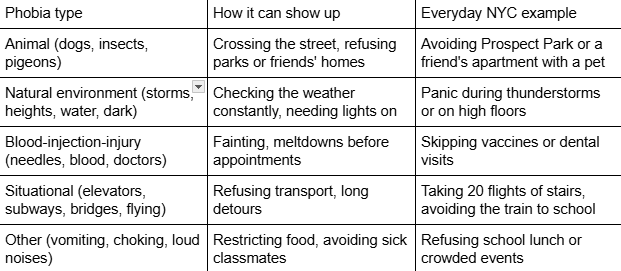
There is rarely a single cause. Phobias usually develop from a mix of factors:
That last point is the key to treatment. Phobias are kept alive by avoidance, so effective care helps children gently stop avoiding.
Phobias respond very well to therapy. Most evidence-based approaches share one idea: helping the child learn, through direct experience, that they can cope with the thing they fear.
Exposure therapy is widely considered the gold standard. The therapist and child build a "fear ladder," a list of situations ranked from slightly uncomfortable to very scary. The child then climbs it step by step, at a pace they agree to. Each time they stay in a scary situation until the fear drops, their brain updates its prediction that something terrible will happen. Many therapists call this "bravery practice," because the child is building confidence, not being forced.
Exposure and Response Prevention (ERP) adds a second piece: resisting safety behaviors such as reassurance-seeking, checking or escaping. It is best known for treating OCD in teens, and the Child Mind Institute also recommends it as the best treatment for specific phobia.
Cognitive behavioral therapy helps older children and teens notice scary predictions ("the elevator will get stuck and I'll never get out"), test them, and replace them with more realistic thoughts. CBT also teaches calming skills such as slow breathing and grounding, which make exposure steps feel more manageable.
For some specific phobias, research supports a single, longer session (often around three hours) of intensive, guided exposure. Randomized trials in the United States, Sweden and the United Kingdom have found that this one-session approach can work as well as longer courses of CBT for many children, making it a practical option for busy families.
Younger kids may not be ready to talk through their fears. Play therapy lets them approach the fear through stories, drawings, puppets and games, such as a stuffed dog that slowly becomes a real one on video, then from a window.
Therapy is the first-line treatment for phobias in children. Medication is rarely needed for a specific phobia on its own, but a psychiatrist may consider it when a child also has significant anxiety, panic attacks or depression, and always alongside therapy.
Here is how a therapist might structure exposure for a nine-year-old with a dog phobia. Each step is repeated until it feels easy before moving up:
The child always has a say in the pace. Therapists praise effort, not just success, and parents practice steps at home between sessions.
Yes. Many parts of phobia treatment translate well to telehealth, including CBT skills, parent coaching and a large share of exposure practice. In some ways online sessions are an advantage, because the therapist can coach your child in real-life settings such as your kitchen, hallway or building elevator, where the fear actually happens. For some fears, such as needles or crowded places, a therapist may combine telehealth with in-person or real-world practice. If you are looking for phobia therapy online, ask whether the clinician has specific training in exposure-based treatment.
Helpful:
Try to avoid:
Pulling back on accommodation is hard for loving parents. A therapist can help you do it step by step, so your child feels supported, not pushed.
Reach out to a mental health professional if your child's fear:
Early treatment matters. Untreated phobias can spread to related fears and increase the risk of other anxiety problems later on.
Mount Behavioral Health is a licensed Article 31 outpatient clinic that supports children, teens and young adults ages 5 to 21. Our clinicians use CBT, ERP, play therapy and family-focused care to help young people face their fears at a pace that feels safe. We offer in-person sessions at our Brooklyn clinic and telehealth across Manhattan, Queens, the Bronx and Staten Island, with parents involved as partners throughout.
Ready to help your child feel braver? Learn more about our phobia therapy for kids and teens in NYC or call us at 718-400-0545 to schedule a consultation.
Exposure-based therapy, usually delivered as part of CBT, is the most effective and best-studied treatment. It helps children gradually face their fear in small, manageable steps.
Specific phobias often begin in childhood, commonly between ages 7 and 11, although they can start earlier or during the teen years.
Many ordinary fears fade with time, but true phobias often persist or grow, especially when avoidance continues. Treatment is usually faster and more reliable than waiting.
Many children improve within 8 to 12 sessions, and some specific phobias respond to a single, longer session. Timelines depend on the child, the fear and any co-occurring concerns.
No. Good exposure therapy is gradual and collaborative. Children agree to each step, and therapists move at a pace that stretches them without overwhelming them.
Yes. CBT skills, parent coaching and many exposure exercises work well online, and practicing in your child's real environment can be a benefit.


