
✕
Share Your Feedback
We’d love to hear from you
Thank you! Your submission has been received!
Oops! Something went wrong while submitting the form.

When a school counsellor or pediatrician suggests "behavioral health services," most parents nod and then quietly wonder what that actually means. It's an umbrella term, and the umbrella is wide. Online behavioral health services cover everything from weekly talk therapy to psychiatric medication management to peer support, all delivered by secure video. This guide breaks down what sits under that umbrella, who each part is for, and how the pieces fit together.
Behavioral health includes mental health conditions such as anxiety and depression, but also behavior itself: how a young person acts at school, how they regulate emotions, how they handle conflict. That's why a clinic might treat a child with panic attacks and a child with explosive anger under the same heading. Both involve patterns that therapy can shift.
The distinction matters when you're searching for help, because the label a clinic uses affects what comes up. A practice describing itself as offering behavioral health services is usually signalling that it handles the full range, including the behavior that shows up in classrooms and living rooms, rather than talk therapy alone. For parents, that's often the more useful door to knock on, since presenting problems in young people rarely arrive neatly sorted into categories.
One clinician, one young person, usually weekly. This is the backbone of most treatment plans. Approaches vary by need: cognitive behavioral therapy for anxious thinking patterns, DBT skills for emotional regulation, play-based work for younger children. The method matters less than the fit between clinician and young person, which is the single strongest predictor of whether therapy helps.
Sessions that include parents, siblings or the whole household. Useful when the difficulty sits in the relationships rather than in one person, or when a child's progress keeps stalling at home.
A prescriber assesses whether medication might help, and if so monitors it over time. This runs alongside therapy rather than replacing it, and many families never need this part at all.
Structured questionnaires and clinical interviews that clarify what's happening before treatment starts. Sometimes a single evaluation is all a family needs to feel oriented.
Trained advocates with lived experience who work alongside young people and parents. It's practical and relational rather than clinical, and it complements therapy well. A peer advocate might sit in on a school meeting, help a teen rehearse a difficult conversation, or simply be someone who has been through something similar and came out the other side.
Clear steps for what to do when things escalate. Any responsible provider will build this into care rather than leaving families to improvise.
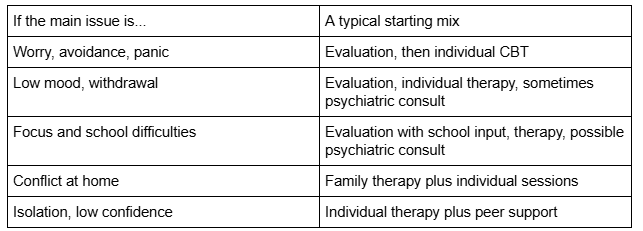
These are starting points, not prescriptions. The evaluation is what tailors them.
Delivery, not substance. The clinician is the same licensed professional, the treatment approach is the same, and the notes and confidentiality rules are the same. What changes is that sessions happen over secure video, which removes travel and makes consistency far easier for families spread across the boroughs. In a city where a cross-borough trip can cost an hour each way, that difference often decides whether a family finishes a course of treatment or drops out after a month.
Some pieces still work better face to face, including certain psychological testing batteries and situations where safety is an active concern. A good clinic will say so rather than pushing everything online.
Online behavioral health services suit young people whose difficulties are interfering with daily life: school, sleep, friendships, family, or their own sense of themselves. You do not need a crisis to qualify, and you do not need to have exhausted every other option first. Earlier support generally means shorter treatment.
Our specialties pages set out the specific areas we work in, and our guide to outpatient mental health therapy explains how this level of care differs from more intensive programs.
Mount Behavioral Health provides online behavioral health services to children, teens and young adults ages 5 to 21 across Brooklyn, Manhattan, Queens, the Bronx and Staten Island, with in-person care at our Brooklyn clinic. If you're unsure which service fits, that's exactly what an evaluation is for. Get in touch or call 718-400-0545.
Mental health usually refers to emotional and psychological wellbeing. Behavioral health includes that plus the behaviors connected to it, such as school refusal or anger outbursts.
For most common concerns in young people, research supports virtual delivery as comparable to in-person care, particularly for anxiety and depression.
Yes, and most do. A common combination is weekly therapy plus periodic psychiatric follow-up, or therapy plus peer support.
No. Many young people are treated with therapy alone. Medication is considered only when it's likely to add something therapy can't.
It varies widely. Focused work on a specific problem may take 8 to 16 sessions, while more complex situations run longer.
Licensed clinicians: psychologists, licensed clinical social workers, mental health counselors, psychiatric nurse practitioners and psychiatrists, depending on the service.
Yes. Providers use secure platforms and the same confidentiality rules apply as in-person, with safety concerns being the standard exception.
This varies by clinic. Mount Behavioral Health works with ages 5 to 21, including young adults in college.
Yes, and you should ask. Fit matters more than almost anything else in therapy, and clinics expect this request.
An evaluation is a reasonable, low-commitment first step. It can equally conclude that no treatment is needed right now.
If your child is in immediate danger or thinking about suicide, call or text 988 (Suicide & Crisis Lifeline) or call 911.


