
✕
Share Your Feedback
We’d love to hear from you
Thank you! Your submission has been received!
Oops! Something went wrong while submitting the form.

Most parents don't arrive at mental health support for youth through a single dramatic moment. It's usually slower: a run of bad weeks, a teacher's comment, a child who used to be chatty going quiet. Then comes the harder part, which is working out what to do about it. This is the roadmap we give families, from the first flicker of worry through to a first appointment, and what to do at each stage.
Every young person has bad weeks. What distinguishes a passing patch from something worth acting on is usually duration and interference. Ask yourself whether this has been going on for more than two or three weeks, and whether it's affecting more than one area of life: school, sleep, friendships, family, appetite, mood at home.
Write down what you're seeing, with rough dates. Parents routinely underestimate how long something has been happening, and a written note is far more useful to a clinician than a general impression. It also helps you see whether things are improving on their own.
Be wary of two opposite traps. The first is explaining everything away as a phase, which is comfortable and sometimes correct but costs time when it isn't. The second is reading catastrophe into ordinary adolescent moodiness, which raises the temperature at home and can make a teenager less likely to talk. The middle path is simply to watch deliberately for a few weeks with a note in your phone, rather than either dismissing it or acting on the worst day.
Before you book anything, say something. Not an interrogation, just an opening. What tends to work:
If they shut it down, that's information too, not failure. You can come back to it. Our piece on knowing whether your child needs therapy covers the signs in more detail.
You don't have to go straight to a therapist. Reasonable first ports of call include your pediatrician, who can rule out physical causes and often refer; the school counselor, who sees your child in a setting you don't; or an outpatient clinic's intake team, who can tell you within one call whether your situation is something they handle.
Any of these can be the starting point. The aim at this stage is orientation, not commitment.
Come with your notes and two or three specific examples. Professionals can work with "she stopped going to practice in October and now eats dinner in her room" far better than "she seems off." If you have a sense of what you want out of the conversation, say that too, whether it's reassurance, a referral, or simply a view on whether this warrants attention at all.
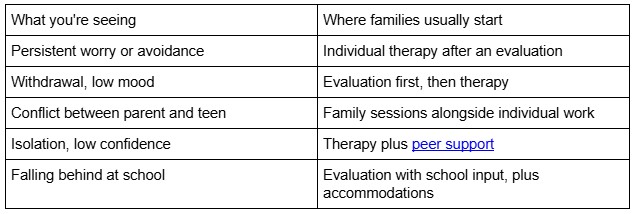
You don't need to pick correctly in advance. An evaluation exists precisely to make this decision properly, drawing on your account, your child's, and often the school's before anything is recommended.
Three things stop more families than reluctance does. Cost: check coverage before the first session; many New York plans including Medicaid cover telehealth mental health visits, and our insurance page sets out what we accept. Scheduling: pick a slot that survives the school term rather than the earliest one offered. Distance: if crossing boroughs is the obstacle, telehealth removes it outright.
Once therapy starts, your job shifts but doesn't end. Protect the appointment time, ask your child how it's going without demanding session details, follow through on anything the clinician asks you to practice at home, and raise concerns directly rather than waiting. Progress is usually gradual, and the families who see the most change are generally the ones who stay engaged between sessions.
Expect the shape of progress to be uneven. Many young people feel slightly worse in the early weeks, when difficult material gets named for the first time, before things settle. That dip is not a sign that therapy is failing, though it is worth mentioning to the clinician so they can explain what they're seeing and adjust the pace if needed.
We work with children, teens and young adults ages 5 to 21 across all five boroughs, offering telehealth citywide and in-person sessions in Brooklyn. If you're at stage one and just want to know whether this is worth acting on, that's a perfectly good reason to call. Contact us or call 718-400-0545.
Duration and interference are the practical tests. Two to three weeks of change that's affecting school, sleep or friendships is worth a professional conversation.
Book a parent consultation for yourself. Clinicians can advise on how to approach a reluctant young person, and many teens agree once they understand what's involved.
Often yes. Teachers see behavior you don't, and schools can put accommodations in place. You control how much you share.
Rarely. Earlier support usually means shorter, simpler treatment, and an evaluation can legitimately conclude that nothing is needed.
Counselors and therapists provide talk therapy. Psychiatrists are medical doctors who can prescribe. Many young people only ever see a therapist.
Not automatically. Therapy is first-line for most concerns in young people, and medication is considered only when it adds something therapy can't.
Typically a copay per session for in-network care. Verify with your plan, as telehealth is often covered at the same rate as in-person visits.
For younger children, usually yes in part. Teens generally need private time with the clinician, with parents joining for updates and planning.
Say so. Changing clinician or approach is common and appropriate, and a good provider will treat it as useful feedback.
Call or text 988 for the Suicide and Crisis Lifeline, or 911 in an emergency. Ask your clinic about their crisis protocol too.
If your child is in immediate danger or thinking about suicide, call or text 988 (Suicide & Crisis Lifeline) or call 911.


