
✕
Share Your Feedback
We’d love to hear from you
Thank you! Your submission has been received!
Oops! Something went wrong while submitting the form.

Manhattan has no shortage of mental health providers. That's exactly what makes choosing one difficult. Search for a licensed therapist offering telehealth in Manhattan and you'll get directories, national platforms, private practices and clinics, with little to tell you which are genuinely licensed to treat your child in New York. This guide covers what to verify before you book, and why a few of those checks matter more than the rest.
This is the check most families skip, and it's the one that makes a licensed therapist telehealth Manhattan search different from simply finding someone nearby. A therapist generally needs to be licensed in the state where the client is physically located during the session, not where the therapist sits. A clinician licensed in New Jersey cannot usually treat your child while they're in an apartment on the Upper West Side.
Ask directly: "Are you licensed in New York?" Any legitimate provider will answer immediately and without irritation. You can verify licenses through the New York State Education Department's public listings.
It matters for continuity too. If your teen goes to college out of state, their New York license may not cover sessions from the dorm, which is worth asking about early.
"Accepts adolescents" is not the same as specializing in them. Working with a 14-year-old requires a different skill set: engaging a reluctant client, managing confidentiality with parents, coordinating with schools, and adjusting technique for a developing brain.
Useful questions: What proportion of your caseload is under 18? How do you handle it when a teenager doesn't want to be there? How do you involve parents? Vague answers to these are informative.
Ask about approach as well. For anxiety you'd expect to hear about cognitive behavioral therapy or exposure work; for emotional regulation, DBT skills; for younger children, play-based methods. You're not testing them on jargon, you're checking that there's a considered method rather than open-ended chat, because structured approaches consistently outperform unfocused sessions with young people.
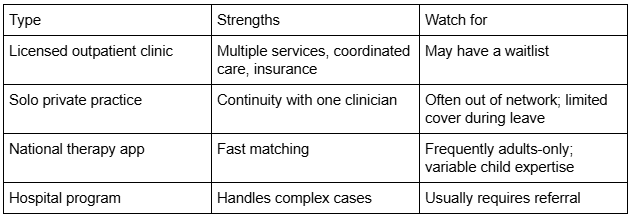
Ask whether they're in network with your specific plan, what the copay is, and whether telehealth is reimbursed at the same rate as in-person visits. Many New York plans including Medicaid cover virtual mental health care. Our insurance page lists what we accept, and our intake team can verify coverage before you commit.
Ask what happens if your child is in distress between sessions or during one. A prepared provider will confirm your location at each session, have a documented protocol, and be able to tell you plainly what they would do. A provider who hasn't thought about it is telling you something important.
Worth asking too: who covers when your clinician is on leave, and how quickly messages between sessions get a response. Solo practitioners can be excellent, but a clinic with colleagues has more resilience when someone is away for two weeks in August, which tends to matter more than families expect.
The borough's density cuts both ways. Providers are nearby, but a cross-town trip at 4pm can still take 40 minutes each way, which for a weekly appointment adds up to most of a school term. Telehealth removes that entirely, makes after-school slots viable, and means a teen at a school far from home can still attend consistently. Consistency, more than anything, is what makes therapy work.
Our Manhattan services sets out what we offer locally, and our guide to choosing the right therapist for your child covers fit in more detail.
Most of these can be answered in a ten-minute conversation with an intake coordinator before you commit to anything:
Write the answers down if you're calling several places. After the third conversation they blur together, and the differences that matter are easy to lose. When comparing a licensed therapist telehealth Manhattan option against a national platform, these six answers usually separate them faster than any amount of website reading.
Mount Behavioral Health is a licensed Article 31 clinic working with children, teens and young adults ages 5 to 21. We provide telehealth across Manhattan and all five boroughs, with in-person sessions available at our Brooklyn clinic. Request an appointment or call 718-400-0545.
Generally yes. Licensure usually follows the client's physical location during the session, so a New York license is what matters.
New York State publishes verification listings for licensed professionals online, and any provider should be willing to give you their license number.
Some are, many aren't. Check whether they treat under-18s, whether clinicians have child training, and how parents are involved.
All can provide therapy with different training routes. Psychologists also conduct psychological testing. For most concerns, any of them may be appropriate.
Yes. With telehealth, the clinic's physical location matters far less than its licensure and availability.
It varies. Virtual intakes are often available within one to two weeks, usually sooner than in-person slots.
Involving them helps engagement considerably, provided the options you offer are all appropriately qualified.
Raise it after a few sessions. Changing clinician is normal, and fit is one of the strongest predictors of whether therapy helps.
Usually not for outpatient clinics, though some insurance plans require one. Check with your plan.
Sometimes, particularly for very young children, active safety concerns or formal psychological testing.
If your child is in immediate danger or thinking about suicide, call or text 988 (Suicide & Crisis Lifeline) or call 911.


